A history of money in France
What changed when France changed its money? In 1960, one new franc replaced 100 old francs. The euro later replaced the franc at a fixed conversion rate. These changes altered the unit used to count an amount; they do not measure what an old wage could buy.Figures computed by FXtab from:Institut national de la statistique et des études économiques (Insee), Franc–euro converter: euro and franc purchasing powerOpens in a new tabEuropean Commission, France and the euroOpens in a new tabGo to the list of sources Source: Institut national de la statistique et des études économiques (Insee), Franc–euro converter: euro and franc purchasing powerOpens in a new tabGo to the list of sourcesSource: European Commission, France and the euroOpens in a new tabGo to the list of sources
Coins before the franc
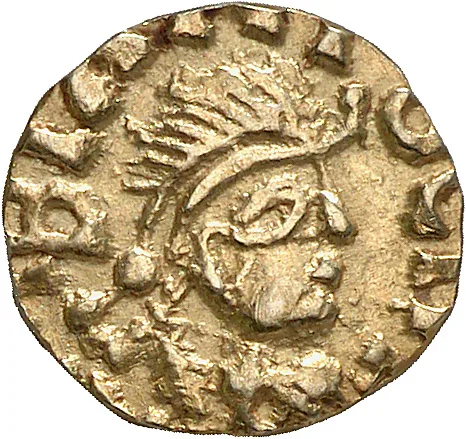
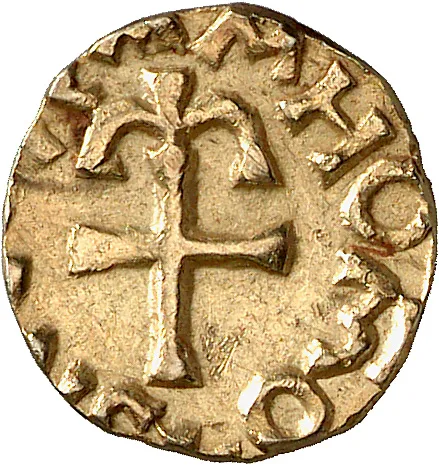
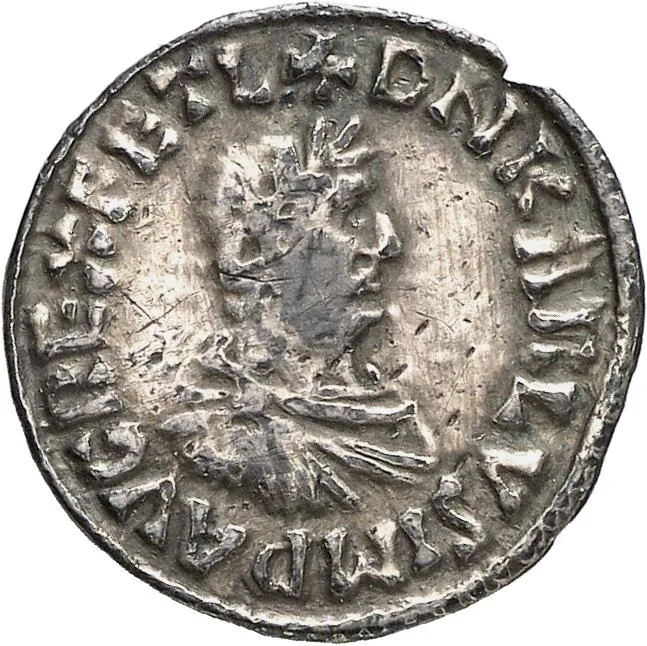
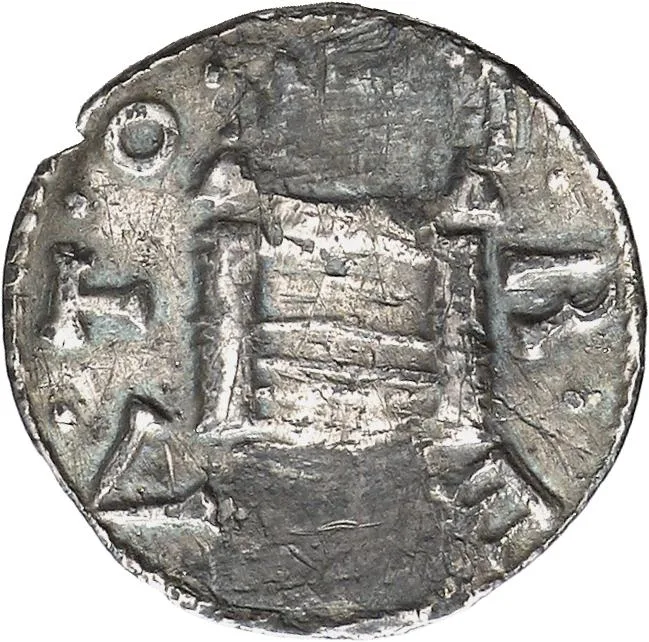
A gold coin struck at Amiens about 620–640 bears a diademed bust and an anchor-shaped cross. Berlin’s Münzkabinett identifies it as a Merovingian issue. The same collection holds a silver coin attributed to Arles and dated in its record to 813–814 or later, with a question mark indicating uncertainty. Charlemagne’s name surrounds a bust wearing a laurel wreath on one face; a city gate appears on the other. The record describes the Arles coin as reworked into jewelry, with traces of gilding and, on the reverse, of a fastening pin.Source: Staatliche Museen zu Berlin, MerowingerOpens in a new tabGo to the list of sourcesSource: Staatliche Museen zu Berlin, Karolinger: Karl der GroßeOpens in a new tabGo to the list of sources
John II’s franc
On December 5, 1360, an order directed the issue of the franc à cheval to help pay the ransom of John II. English forces had captured the French king at Poitiers in 1356. The Library of Congress records this example as a gold coin. It shows the mounted king raising a sword as his horse gallops left. The Library of Congress record relates the name franc, meaning free, to the king’s release.Source: Library of Congress, World Digital Library, Franc à cheval, John IIOpens in a new tabGo to the list of sources
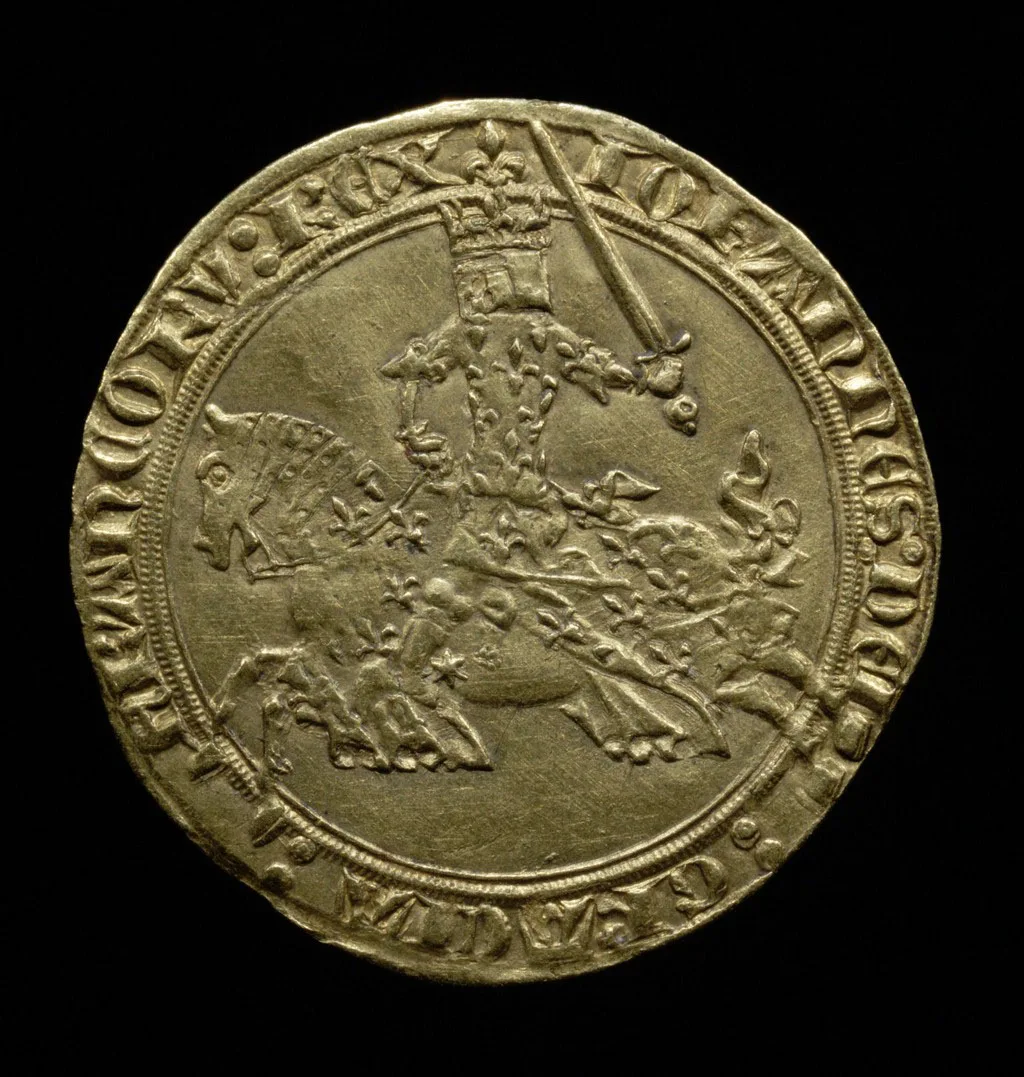
Authorities set the coin’s value at one livre tournois, the Tours pound. The word franc became a synonym for pound. During the French Revolution, the franc became France’s national currency.Source: Library of Congress, World Digital Library, Franc à cheval, John IIOpens in a new tabGo to the list of sources
John Law’s bank and payments to the treasury
The 1826 text dates the authorization of Law’s bank by edict to May 2, 1716. It describes notes payable to the bearer in écus of the weight and fineness current that day (p. 15, also numbered 63). That promise specified the characteristics of the coins the note holder could demand.Source: HathiTrust Digital Library, Law (1826), printed page 15 / 63: original scanOpens in a new tabGo to the list of sourcesSource: HathiTrust Digital Library, HathiTrust bibliographic record for Law (1826)Opens in a new tabGo to the list of sources
Levasseur places the first order to send treasury receipts to Paris in banknotes in October 1716 (pp. 49–51). He reproduces Noailles’s letter to the intendants, the provincial officials, instructing them to direct the tax receivers; its heading instead gives October 7, 1717. A further letter of December 26, 1716 relaxed the instruction. Receivers could still use their previous methods to remit the remaining funds, while remaining obliged to pay banknotes presented to them.Source: Levasseur historical works, Émile Levasseur, Recherches historiques sur le système de Law (1854)Opens in a new tabGo to the list of sources
Lost confidence and the Germinal franc
Banque de France First Deputy Governor Denis Beau traces the loss of confidence in French money to several eighteenth-century failures. John Law’s note-issuing bank went bankrupt in 1720. Monetary financing of wars during the Revolution fueled hyperinflation, followed by a default on two-thirds of public debt in 1797.Source: Banque de France, The Banque de France over the years: Serving the regions and its inhabitantsOpens in a new tabGo to the list of sources
Pamfili Antipa traces the assignats through distinct phases. From 1790 to late summer 1793, inflation remained subdued while sales of confiscated church land brought in revenue behind the new paper money. With the declaration of war in April 1792, debt payments were suspended and inflation increased. The Reign of Terror then imposed controls on prices and wages. Once those restrictions disappeared after the Jacobins fell in 1794, the assignat lacked both metal backing and a stream of public revenue. Inflation surged in 1795–1796.Source: Banque de France, The fiscal roots of hyperinflation: a historical perspectiveOpens in a new tabGo to the list of sources
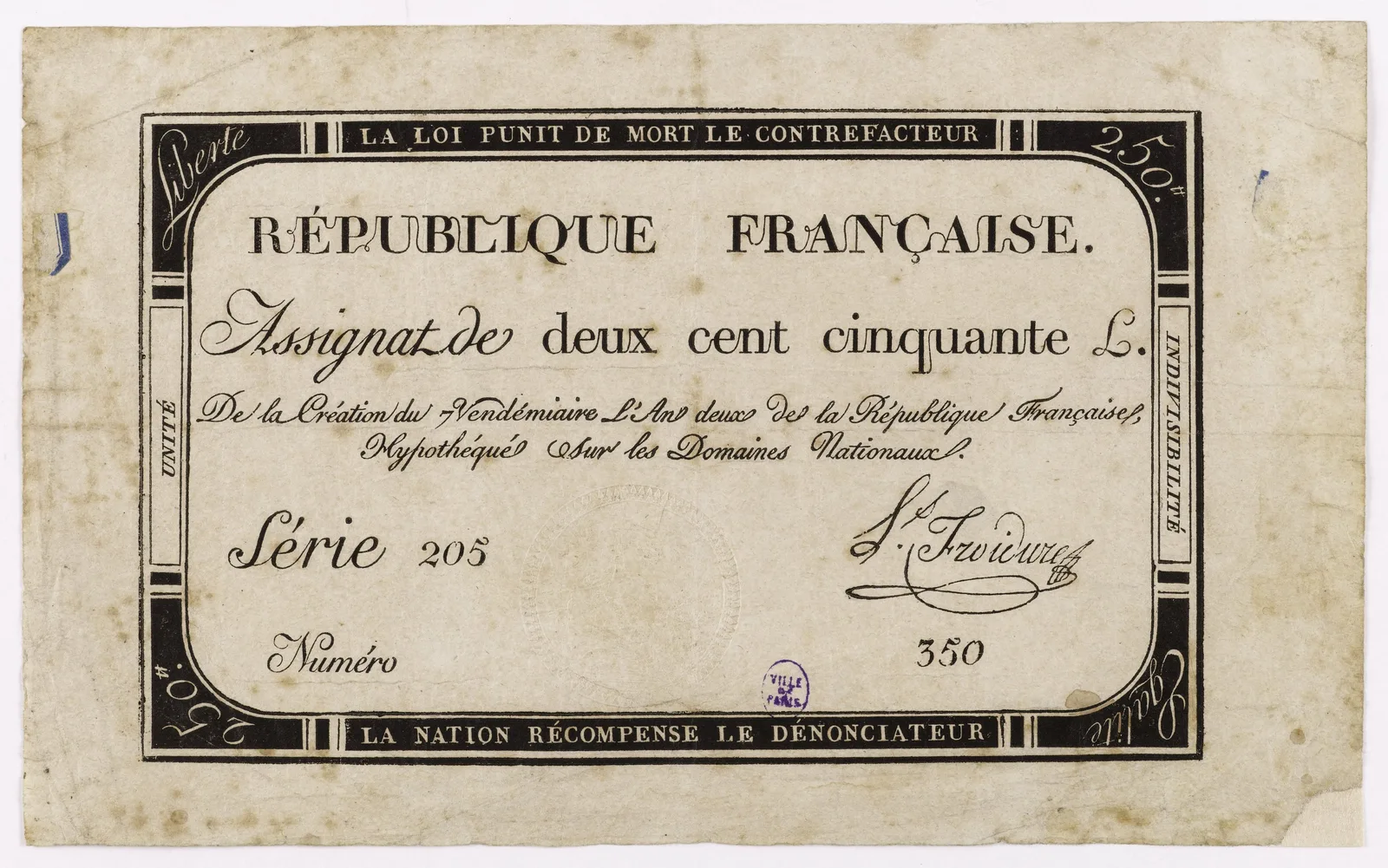
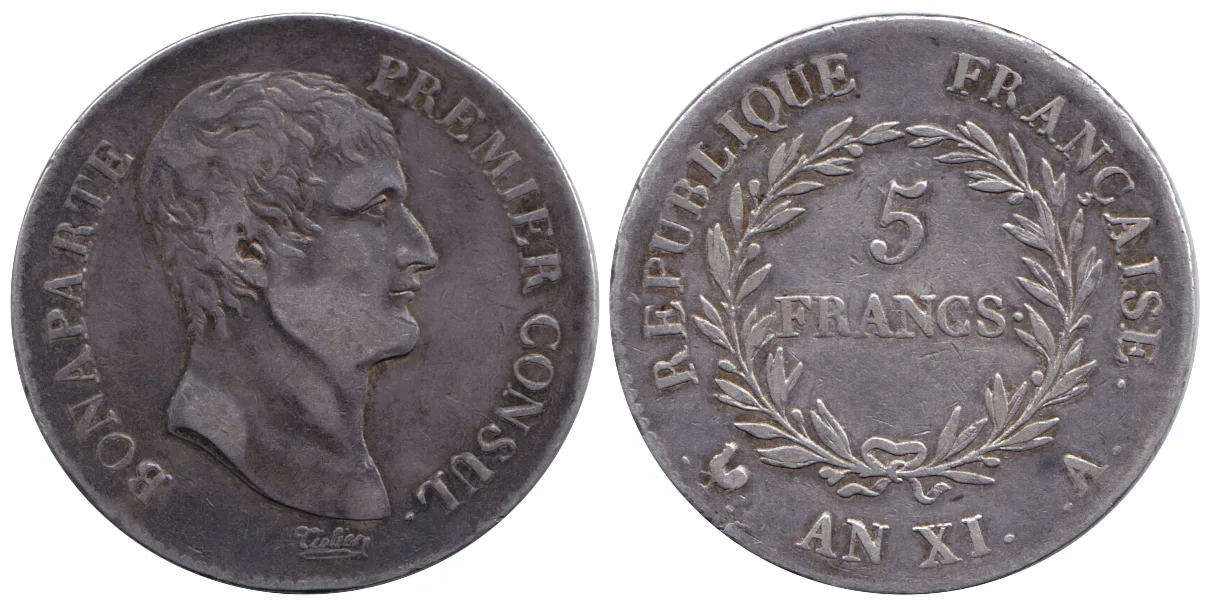
Beau describes the establishment of the France’s central bank, established in 1800.Source: Banque de France, The Banque de France over the years: Serving the regions and its inhabitantsOpens in a new tab in 1800 and the Germinal franc in 1803 as responses to that loss of confidence. The bank could adjust its money supply to the needs of the economy because the public trusted it.Source: Banque de France, The Banque de France over the years: Serving the regions and its inhabitantsOpens in a new tabGo to the list of sources
The coinage law is listed under two dates: 7 and 17 Germinal Year XI (March 28 and April 7, 1803). That law defined the franc through five grams of silver at nine-tenths fineness. It provided for silver coins from a quarter franc to five francs, and gold coins of twenty and forty francs.Source: French law of 17 germinal Year XI in Bulletin annoté des lois, décrets et ordonnances (1834), Bulletin annoté des lois, décrets et ordonnances, tome neuvième (1834), loi du 17 germinal an XI, pp. 529–531Opens in a new tabGo to the list of sources
The Banque de France and its notes
Banknotes had a different institutional history. Founded on January 18, 1800, the Banque de France was initially a private company. It issued notes payable on demand to whoever held them, in exchange for discounting commercial bills. In 1803 it gained the privilege of issuing notes in Paris.Source: Banque de France, The history of the Banque de FranceOpens in a new tabGo to the list of sources Source: Banque de France, The Banque de France over the years: Serving the regions and its inhabitantsOpens in a new tabGo to the list of sources
In 1848 it gained a monopoly on issuing notes across France, when departmental banks became its branches. During the First World War, the bank helped the state borrow and collect privately held gold. German occupation later brought demands to handle France’s payments to the occupying power. Nationalization followed in December 1945, making the bank state-owned.Source: Banque de France, The history of the Banque de FranceOpens in a new tabGo to the list of sources
A mint on the quai de Conti
Coin production also needed premises and machinery. The Lazares’ 1844 dictionary reproduces letters patent of April 16, 1768 assigning the new Hôtel des Monnaies to the former Conti properties. The dictionary’s description names Jacques-Denis Antoine as the architect. It places the coining room at the far end of the main courtyard, apart from other buildings to limit the vibration from its presses (pp. 456–457).Source: Félix and Louis Lazare, 1844 dictionary, Félix and Louis Lazare, Monnaies (hôtel des), 1844Opens in a new tabGo to the list of sources
In his 1868 account of the mint, Du Camp listed gold coins up to one hundred francs, silver coins up to five francs, and bronze coins down to one centime.Source: Maxime Du Camp, Maxime Du Camp, L’Hôtel des Monnaies de Paris (1868)Opens in a new tabGo to the list of sources
Stabilization and the new franc
After the First World War, government finances deteriorated and the franc fell on foreign exchange markets. Under governor Émile Moreau, the Banque de France stabilized the franc’s rate in late 1926. The monetary law of June 25, 1928 established the Poincaré franc. Stabilization accepted a lower value than before the war.Source: Banque de France, Governing the Banque de France: two lessons from history for an uncertain worldOpens in a new tabGo to the list of sources
In a later account, governor François Villeroy de Galhau describes the decision as devaluation from its pre-war parity
Source: Banque de France, Governing the Banque de France: two lessons from history for an uncertain worldOpens in a new tabGo to the list of sources. It differs from changing the unit in which the same amount is counted.
France undertook the De Gaulle-Pinay-Rueff financial stabilization plan in 1958. In 1960, the new franc replaced 100 old francs. An amount of 10,000 old francs became 100 new francs. Changing those digits did not, by itself, change the goods that amount could buy.Figures computed by FXtab from:Institut national de la statistique et des études économiques (Insee), Franc–euro converter: euro and franc purchasing powerOpens in a new tabEuropean Commission, France and the euroOpens in a new tabGo to the list of sources Source: Banque de France, Governing the Banque de France: two lessons from history for an uncertain worldOpens in a new tabGo to the list of sources Source: Institut national de la statistique et des études économiques (Insee), Franc–euro converter: euro and franc purchasing powerOpens in a new tabGo to the list of sources
From the franc to the euro
In 1983, the government implemented budget savings and de-indexation measures to keep France in the An arrangement for monetary cooperation among European countries. Participating currencies had limits on their exchange-rate movements, supported by central-bank intervention.Source: Banque de France, Governing the Banque de France: two lessons from history for an uncertain worldOpens in a new tab. When currencies came under pressure in 1992–1993, the Banque de France intervened to support the franc. Wider permitted exchange-rate movements helped resolve the crisis.Source: Banque de France, Governing the Banque de France: two lessons from history for an uncertain worldOpens in a new tabGo to the list of sources
The Banque de France gained independence under the law of August 4, 1993. It joined the The European Central Bank and the national central banks of EU countries that use the euro. Together they conduct monetary policy for the euro area.Source: Deutsche Bundesbank, GlossaryOpens in a new tab when the euro began on January 1, 1999. Euro cash arrived on January 1, 2002; the period in which both currencies could be used ended on February 17, 2002.Source: Banque de France, The history of the Banque de FranceOpens in a new tabGo to the list of sources Source: European Commission, France and the euroOpens in a new tabGo to the list of sources
One euro replaced 6.55957 francs. Dividing 100 francs by the full fixed conversion rate gives €15.24, rounded to cents. The Banque de France exchanged franc coins until February 17, 2005 and franc banknotes until February 17, 2012.Figures computed by FXtab from:Institut national de la statistique et des études économiques (Insee), Franc–euro converter: euro and franc purchasing powerOpens in a new tabEuropean Commission, France and the euroOpens in a new tabGo to the list of sources Source: European Commission, France and the euroOpens in a new tabGo to the list of sources
The same amount, in different units
- Old francs10,000an illustrative starting amount.Figures computed by FXtab from:Institut national de la statistique et des études économiques (Insee), Franc–euro converter: euro and franc purchasing powerOpens in a new tabEuropean Commission, France and the euroOpens in a new tabGo to the list of sources
- Francs from 1960100divide old francs by 100.Figures computed by FXtab from:Institut national de la statistique et des études économiques (Insee), Franc–euro converter: euro and franc purchasing powerOpens in a new tabEuropean Commission, France and the euroOpens in a new tabGo to the list of sources
- Euros€15.24divide francs by 6.55957, then round to cents.Figures computed by FXtab from:Institut national de la statistique et des études économiques (Insee), Franc–euro converter: euro and franc purchasing powerOpens in a new tabEuropean Commission, France and the euroOpens in a new tabGo to the list of sources
What an old price could buy
The National Institute of Statistics and Economic Studies.Source: Institut national de la statistique et des études économiques (Insee), Legal noticeOpens in a new tab, France’s statistical institute, distinguishes currency conversion from purchasing power, the goods and services a unit of money can buy. Its historical converter adjusts an amount for changes in the consumer price index, which estimates average changes in the prices of goods consumed by households.Source: Institut national de la statistique et des études économiques (Insee), Purchasing power of currencyOpens in a new tabGo to the list of sources Source: Institut national de la statistique et des études économiques (Insee), L’InseeOpens in a new tabGo to the list of sources Source: Institut national de la statistique et des études économiques (Insee), Franc–euro converter: euro and franc purchasing powerOpens in a new tabGo to the list of sources
Insee illustrates the difference with a baguette priced at 3.80 francs in 1995. Converting the unit alone gives €0.58. Adjusting for the general rise in prices gives €0.93 in 2025 in Insee’s example. Figures computed by FXtab from:Institut national de la statistique et des études économiques (Insee), Franc–euro converter: euro and franc purchasing powerOpens in a new tabEuropean Commission, France and the euroOpens in a new tabGo to the list of sources Source: Institut national de la statistique et des études économiques (Insee), Franc–euro converter: euro and franc purchasing powerOpens in a new tabGo to the list of sources
An old wage raises the same question. Insee’s method uses annual average price indices, with the households and territory covered changing over the historical series. Such a comparison measures changes in purchasing power.Source: Institut national de la statistique et des études économiques (Insee), Franc–euro converter: euro and franc purchasing powerOpens in a new tabGo to the list of sources
Sources
Historical sources: the Banque de France institutional website. Denis Beau’s speech and Pamfili Antipa’s post were updated on September 24, 2026; François Villeroy de Galhau’s speech is from 2025. Institutional history (undated): archived copy retrieved on September 30, 2026. The assignats passage adapts Antipa’s Banque de France post, updated on September 24, 2026. FXtab has shortened and reworded the text without using its charts.
The Amiens and Arles coin descriptions adapt the Berlin Münzkabinett’s Merovingian and Carolingian records under CC BY-SA 4.0; the adaptations are shared under the same license. Each photograph has its own credit.
Source: Insee for the purchasing-power method and illustrative bakery price, retrieved September 30, 2026. FXtab calculated the amounts; photographs retain their individual credits.